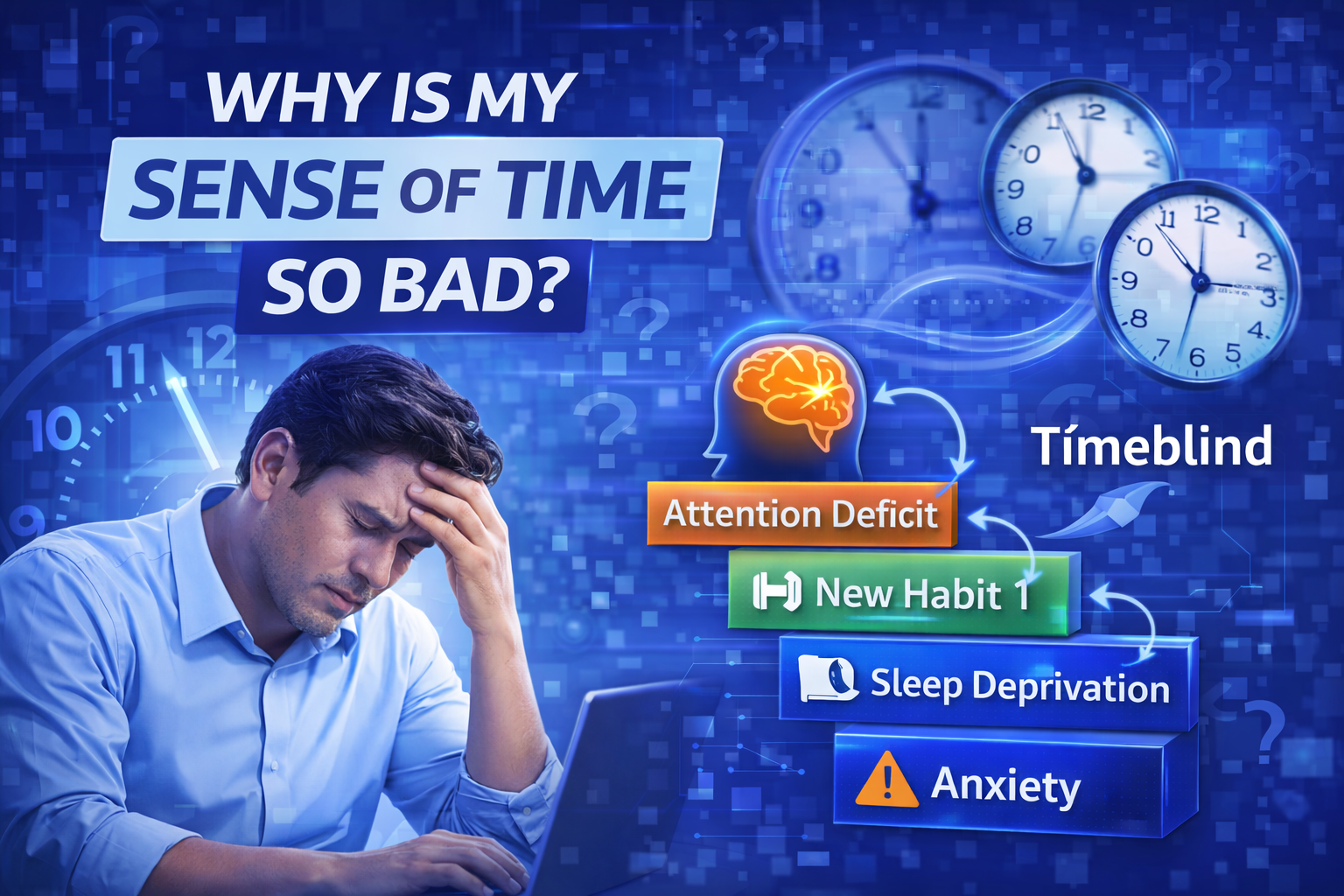
If you keep thinking, why is my sense of time so bad, you are dealing with a real cognitive problem, not a personal failure. Your brain builds a sense of time from attention, memory, and motivation, so it can drift when any of those systems are strained.
Once you understand the specific reason your timing feels unreliable, you can use practical tools that make daily life feel calmer and more predictable. Read for more information on this topic.
What a “Bad Sense of Time” Looks Like Day to Day
A poor sense of time usually means you misjudge duration and you miss transitions between tasks. You might start getting ready and believe you have plenty of time, only to suddenly be late and not understand where the minutes went. That mismatch often shows up as rushed mornings, unfinished tasks, and a constant feeling that your schedule is chasing you.
You can also experience the opposite problem: arriving very early because you do not trust your own estimates. This is common when you have been burned by lateness many times and you overcorrect to avoid it. The result is still stressful because it wastes time and keeps your mind stuck in “waiting mode.”
Many people notice that time flies during stimulating activities and drags during boring ones. That contrast is a major clue because it points to attention as the core driver of your time experience. Your brain does not track time like a clock, it tracks changes in focus and memory.
How Your Brain Creates Time Perception
Your brain does not store time as a single measurable object, it reconstructs time from signals and patterns. Networks involving the prefrontal cortex help with planning and time monitoring, while other systems support sequencing and estimating duration. When these networks do not coordinate smoothly, your internal timing becomes inconsistent.
Dopamine is one of the most important chemicals linked to attention and time estimation. When dopamine signaling is disrupted, your brain can struggle to “feel” the passage of time accurately. This is why a task can feel endless one day and disappear the next.
Mind wandering can also distort time by pulling your attention away from the present moment. If the default mode network activates heavily, your thoughts drift, and your awareness of minutes passing becomes weaker. The clock keeps ticking, but your brain stops reliably tracking it.
ADHD Time Blindness and Why It Hits So Hard
If you have ADHD, you may experience time blindness, which is difficulty sensing time passing and predicting how long things will take. You can genuinely intend to start early, but the future doesn’t feel urgent until the deadline is near. That is why last-minute pressure can become the only thing that triggers action.
Time blindness also distorts your time horizon, meaning long-term outcomes feel less real than immediate stimulation. You might choose what feels rewarding now, even when you care deeply about a future goal. This is not laziness; it is a brain-based difference in how urgency is processed.
ADHD time blindness often shows up as chronic lateness, missed appointments, and underestimating task length. It can also manifest as hyperfocus, where you become so absorbed that hours pass without your awareness. When you recognize this pattern, you can build external structure that protects you from your own inaccurate timing.
Processing Speed and the “This Should Take 10 Minutes” Trap
Processing speed is the pace at which you take in information and respond to it. When your processing speed is slower, tasks require more cognitive steps than you expect, so your time estimates become optimistic. You are not failing; you are predicting time using a pace your brain cannot sustain consistently.
This is why simple tasks can feel surprisingly heavy, especially when you are tired or distracted. Your brain has to work harder to start, switch, and finish, which adds hidden minutes you do not count. If you plan like those hidden minutes do not exist, your schedule will collapse.
Boredom can make this worse, as low interest reduces mental energy and slows your pace further. You can start strong, then hit resistance and drift into avoidance, scrolling, or daydreaming. The task still has to be done, but you now have less time and more stress.
Emotions That Warp Time and Reduce Accuracy
Anxiety can stretch time because your brain becomes hyper-alert and you notice each moment more intensely. Stress narrows attention to perceived threats, making minutes feel long and uncomfortable. You may feel busy and pressured even when you have not completed much.
Excitement and enjoyment often compress time because you stop monitoring the clock. When you are engaged, your attention stays locked in and you create fewer internal “time checks.” This is why you can look up and realize you lost an hour without noticing.
Low mood can distort time, making tasks feel heavier and slower. When motivation is low, your brain predicts discomfort and delays starting, which pushes you into last-minute action. Emotional regulation matters because stable emotion supports stable attention, and stable attention supports better timing.
Attention, Memory, and Why Some Days Disappear
Your brain uses memory formation as a rough record of time. When your day contains novelty, your brain stores more details, so the day feels longer in hindsight. When your day repeats the same patterns, fewer memories stand out, and time feels like it vanished.
Attention determines how much detail your brain records. If you multitask constantly, your attention fragments and your brain stores fewer complete moments. That makes the day feel blurrier and harder to evaluate.
You can improve this by building intentional time anchors, such as a short pause to review what you just finished. A simple journaling habit or quick recap after a task increases memory density. When you remember more, you estimate time better because your brain has clearer reference points.
Common Signs You Are Struggling With Time Awareness
One sign is repeatedly underestimating transition time, such as getting dressed, packing, parking, or logging in. You may plan for the main task but forget the steps around it, so you always feel behind. These hidden steps are real time costs that your brain tends to ignore.
Another sign is waiting mode, where you cannot begin anything before an appointment. Your mind treats the upcoming event as urgent, even if it is hours away, so you freeze. This creates a frustrating cycle where you waste time and then feel guilty.
A third sign is losing time to hyperfocus or distraction. Hyperfocus can feel productive, but it often ignores meals, breaks, and deadlines. Distraction feels harmless until you check the clock and realize the task window is gone.
Build Time Awareness With Simple External Structure
The most reliable fix is to stop relying on your internal clock and start using external cues. Set alarms for start times, transition times, and a final “leave now” moment, not just a reminder. This reduces the chance that you will drift and miss the point of no return.
Use visible time tools so you can see time passing instead of guessing it. When you need quick reference points for everyday planning, the guide on how many minutes different chunks of time contain can help you visualize what you can realistically finish. That mental picture makes your schedule feel more concrete.
Keep one clock in your workspace and one in the room where you get ready. If you work on a laptop, place a small timer on the desk so you do not have to change screens. The goal is to make time impossible to ignore without making it stressful.
Better Estimation Through Logging and Buffers
If your estimates are consistently wrong, track the truth for two weeks. Write down how long key tasks actually take, including transitions and interruptions. Once you have real numbers, you can plan with accuracy instead of hope.
Add buffers between tasks, especially for anything that involves travel, switching tools, or waiting on someone else. A 10-minute buffer prevents a single delay from ruining your entire afternoon. Buffers also reduce anxiety because you no longer feel trapped by a perfect schedule.
When you struggle to sense duration in the moment, practice estimating and then checking with a timer. You can also use the breakdown on how much time common activities really require to set more realistic expectations. Over time, your brain calibrates, and your estimates become closer to reality.
Focus Methods That Prevent Time Drift
Time drift happens when you start without clear boundaries. Give each work session a defined start, a clear target, and a firm stopping point. This structure reduces impulsive switching and helps your brain stay oriented.
Use short work intervals to create repeated “time check” moments. A tool like the 3 Minutes Timer for better focus can help you begin when you feel stuck, because three minutes feels doable even on low-motivation days. Once you start, momentum often carries you into a longer work block.
Pair timers with a single task list so you do not spend your work interval deciding what to do. Write the next action in plain language and begin immediately when the timer starts. This prevents decision paralysis and helps you stay aware of time passing.
When Poor Time Sense Signals a Bigger Issue
If timing problems damage your job performance or relationships, it is worth considering an evaluation. ADHD, anxiety, depression, and sleep disorders can all impair attention and executive function, which directly harms time perception. Identifying the cause matters because the right support depends on what is driving the pattern.
Medication can improve time perception for some people with ADHD because it supports attention and dopamine regulation. Coaching and therapy can also help by building routines, reducing shame, and strengthening planning systems. The most effective approach is usually a mix of tools and behavioral strategy, not motivation alone.
Sleep is a major factor that many people underestimate. Adults generally need at least seven hours of sleep per night for stable cognition, and chronic sleep loss worsens focus and working memory. If you fix sleep but still struggle, professional support can help you target the root cause more quickly.
Conclusion
When you ask, why is my sense of time so bad, the answer is usually a mix of attention, memory, emotion, and brain chemistry working out of sync. Your timing problems are often predictable once you notice patterns like hyperfocus, waiting mode, underestimating transitions, or needing urgency to start. You regain control by externalizing time with visible cues, building buffers, tracking real durations, and using short, structured focus sessions that keep your brain oriented.
If these issues have followed you for years, treat them like a solvable skills gap, not a personality flaw. Start with one or two systems you can repeat daily, then expand once they feel automatic. With consistent structure and the right support, your time awareness can improve, and your days can feel far less chaotic.

Jammie Justice
Jammie Justice is an accomplished tech writer with a keen eye for emerging technologies and a knack for breaking down complex topics into reader-friendly insights. With a background in software engineering and hands-on experience in full-stack development, she covers everything from API design and cybersecurity to cloud-native architectures. Jammie’s articles and tutorials empower developers and tech enthusiasts to adopt best practices, troubleshoot common pitfalls, and stay ahead of industry trends. Her clear, conversational style and commitment to accuracy make her a trusted voice in the tech community.